
I don’t know about you, but I love learning new things. There’s something exhilarating about that “aha!” moment when a skill you’ve been grappling with finally clicks. And let me tell you, one of the fastest means to acquire new skills is via mentoring.
But don’t be deceived by thinking mentoring is only about learning new skills like coding or creating the perfect PowerPoint. Nope, it’s so much more. Mentorship also offers several other intangible qualities that can help advance their careers from good to great. I’m talking about communication, leadership, problem-solving, and many more.
And get this mentoring for employees development comes in all shapes and sizes. You’ve got the traditional one-on-one mentoring that needs no introduction. Then, there’s peer mentoring, because sometimes you just want to chat with someone who’s in the same boat as you. There’s even reverse mentoring where the mentee becomes the mentor, and TONS more.
Irrespective of the type, what’s certain is that encouraging a culture of mentoring in the workplace should be a no-brainer. That’s why today I’m dedicating this post to talk about what mentoring in the workplace is, why it’s vital, and how to maximize it!

What is Mentoring in the Workplace?
Well, imagine having a personal guide in your professional journey. Someone who’s been there, done that, and is willing to share their map to success with you. That’s workplace mentoring in a nutshell!
At its core, mentoring in the workplace is a partnership between two colleagues typically a more experienced employee (the mentor) and a less experienced one (the mentee). But this is not just an ordinary relationship or partnership. Mentorship is all about growth, learning, and support. The mentor takes the mentee under their wing, sharing insights, offering guidance, and sometimes even throwing in a few life hacks they’ve picked up along the way.
Mind you, this is not a one-way street kind of relationship. The mentee isn’t the only beneficiary here. The mentor also gains a number of things. I’ll be shedding more light on this and more shortly…
Why is Mentoring Important in the Workplace?
The beauty of mentoring is that it’s something for every party involved. As I mentioned earlier, it isn’t a one-way street type of relationship. Let’s start with how mentees gain from this so-called “mutually beneficial” relationship.
Newbies are perhaps the biggest beneficiaries of mentorship. Thanks to their mentor, they quickly understand the lay of the land. Mentors give them the heads-up on how to navigate office politics, understand the organizational culture, and avoid those rookie mistakes we all dread. You can read more on this in our post on how leadership influences organizational culture.
But it’s not all about mentors! Even if you’ve been around the block a few times, a mentor can help you break through that career goal ceiling. They can provide fresh perspectives, challenge your thinking, and push you out of your comfort zone.
Now, let’s talk about mentors. How exactly do they gain from such a relationship? When the higher-ups take up the mentorship mantle, they are essentially, and at times unknowingly, embracing an opportunity for personal growth and development.
Mentorship programs in the workplace is how managers become leaders. As a leader, mentoring helps you gain fresh perspectives and sharpen your leadership skills. You may even learn a thing or two about the latest industry trends from your mentee. Plus, there’s a huge bonus. There’s something incredibly rewarding about helping others grow. It’s like watering a plant and watching it bloom but instead of a plant, it’s a person’s career!
As individuals enjoy mutual gains, so also does the organization as a whole. The interplay between mentors and their mentees creates a sense of community, fosters empathy, and builds stronger professional relationships. It helps create a work environment where people don’t just come to do a job. Rather, each working day presents another opportunity for everyone to grow, learn, and support each other.
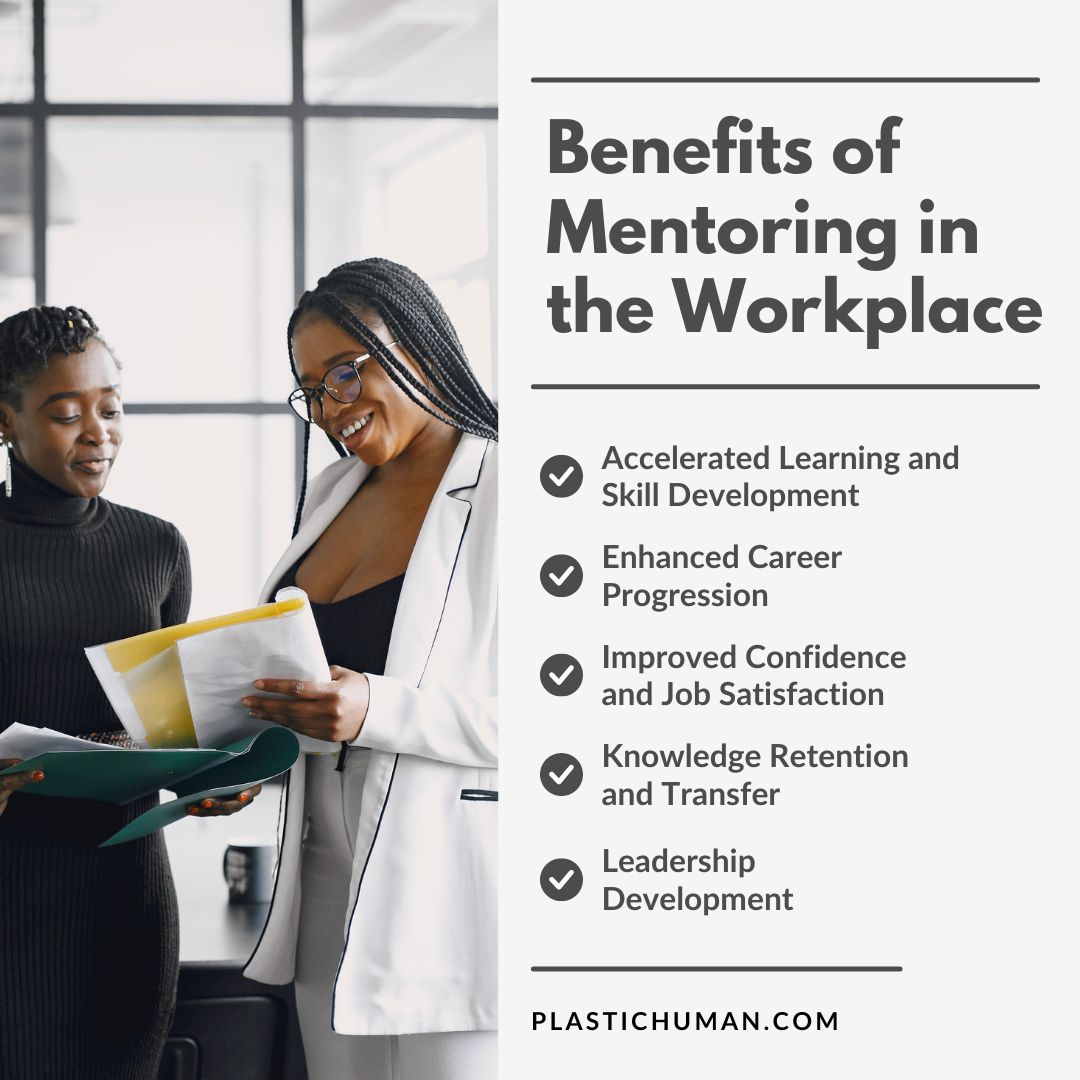
5 Benefits of Mentoring in the Workplace
It’s time to touch on the exact benefits of fostering a mentorship culture in the workplace.
Accelerated Learning and Skill Development
Remember when you were a kid and you learned to ride a bike? Having someone there to guide you, give you tips, and catch you when you wobble made all the difference. That’s what mentoring does in the workplace.
For employees, it’s like having a fast-forward button for professional development of skills. Instead of figuring everything out through trial and error, you have someone who was once in your shoes as your guide. He or she can even show you the shortcuts. This is also good news for your organization since you’ll have a workforce that’s constantly evolving and improving.
Enhanced Career Progression
Let’s face it sometimes, climbing the career ladder can feel like you’re scaling a greased pole. But with a mentor in your corner, you’ve got someone to give you a boost. He or she can help you set realistic goals and identify areas for improvement. And guess what? Your boss and mentor may even put in a good word for you with the upper management level when opportunities arise.
It gets better, though! Having a mentorship culture means a higher retention rate of top talents in your organization. After all, your best employees are less likely to seek greener pastures when there’s a clear progression path.
Improved Confidence and Job Satisfaction
Having a mentor means employees don’t have to do trial and error. Instead, they follow a working formula and become more productive, which boosts their confidence considerably. When you feel good about your abilities and your future prospects, work becomes less of a chore and more of an opportunity. After all, happy employees are motivated and productive employees. You’ll also have greater job satisfaction.
Knowledge Retention and Transfer
Every organization has that one person who knows everything the human encyclopedia of company knowledge. But what happens when they retire or move on? Hence, it’s really important they share that knowledge via mentoring, either to individuals or groups. Knowledge retention and transfer will also afford newbies the opportunity to tap into their wealth of knowledge and learn things that aren’t in any manual or training program.
Leadership Development
Mentoring is also a means to build leaders of tomorrow. Mentees indirectly take the front row seat and observe leadership in action. They get to see how decisions are made, challenges are tackled, and teams are inspired. With time, mentors can pass on the baton to their mentees-turned-mentors. And like other mentors before them, they get to practice and refine their leadership skills. I’m talking about skills like active listening, effective communication, empathy, and the ability to guide without dictating.
5 Challenges of Mentoring in the Workplace
Mentoring is indeed a powerful tool for professional growth and organizational success. However, it’s not without its hurdles.
Time Constraints
Let’s face it, there’s always so much to do but so little time in our fast-paced work environments. So, having to add mentorship to your already-overbooked daily tasks can be quite an ask. The same goes for a mentee who may be feeling overwhelmed with work already or struggling. But he or she is still expected to carve out time for mentoring sessions and related activities.
How to overcome this challenge: schedule regular but realistic meeting times so you can plan ahead. However, focus on quality over quantity. A focused 30-minute session is more valuable than a meandering two-hour meeting. You can also use video calls, instant messaging, or a mentoring software from time-to-time rather than face-to-face meetings every time.
Mismatched Expectations
Sometimes, mentoring relationships can feel like a blind date gone wrong. Mentors and mentees may come into this relationship with very different ideas. Mentees may be disappointed if they’re hoping for daily guidance but the mentor only checks in once a month. On the other hand, the mentor may become frustrated thinking his mentee expects him to always check in to solve all their problems.
Proper communication from the get-go will prevent such a situation. Each party should clearly state their expectations, goals, and boundaries. Also, there should be an agreement outlining the frequency of meetings and desired outcomes.
Generational Gaps
The age gap between the mentor and mentee can also be an issue. That’s because of possible differences in communication styles, work ethics, and technological preferences.
How can you overcome such a tricky situation? Both parties need to focus on commonalities rather than differences. Shared goals and values can bridge generational gaps. And most importantly, they should be willing to learn from each other. The mentor might know the industry inside out, but the mentee might be a whiz at the latest tech tools.
Lack of Training
Just because someone is great at their job doesn’t automatically make them a great mentor. Mentoring is a skill that may not yield the desired result when they don’t have mentoring training. For instance, some mentors are guilty of micromanagement or becoming too hands-off. That’s why everyone needs to undergo regular training, mentor and mentee alike. This can help them learn and develop effective mentoring practices.
Resistance to Feedback
Feedback, at times, can be a double-edged sword. When it’s favorable, we feel on top of the world. However, it can be hard to swallow sometimes. This human tendency to embrace positive feedback and resist constructive or even painful feedback is another issue that often arises during mentorship. Mentors can be frustrated that their well-intentioned advice keeps falling on deaf ears. Mentees, however, may become too defensive or let fear of criticism prevent them from truly benefiting from their mentor’s insights.
To overcome this, it’s important to create a safe, non-judgmental environment for open communication. Both parties should also strive to give constructive criticisms, not destructive ones. Check out how to resolve conflicts between managers and employees for some strategies to minimize this challenge.
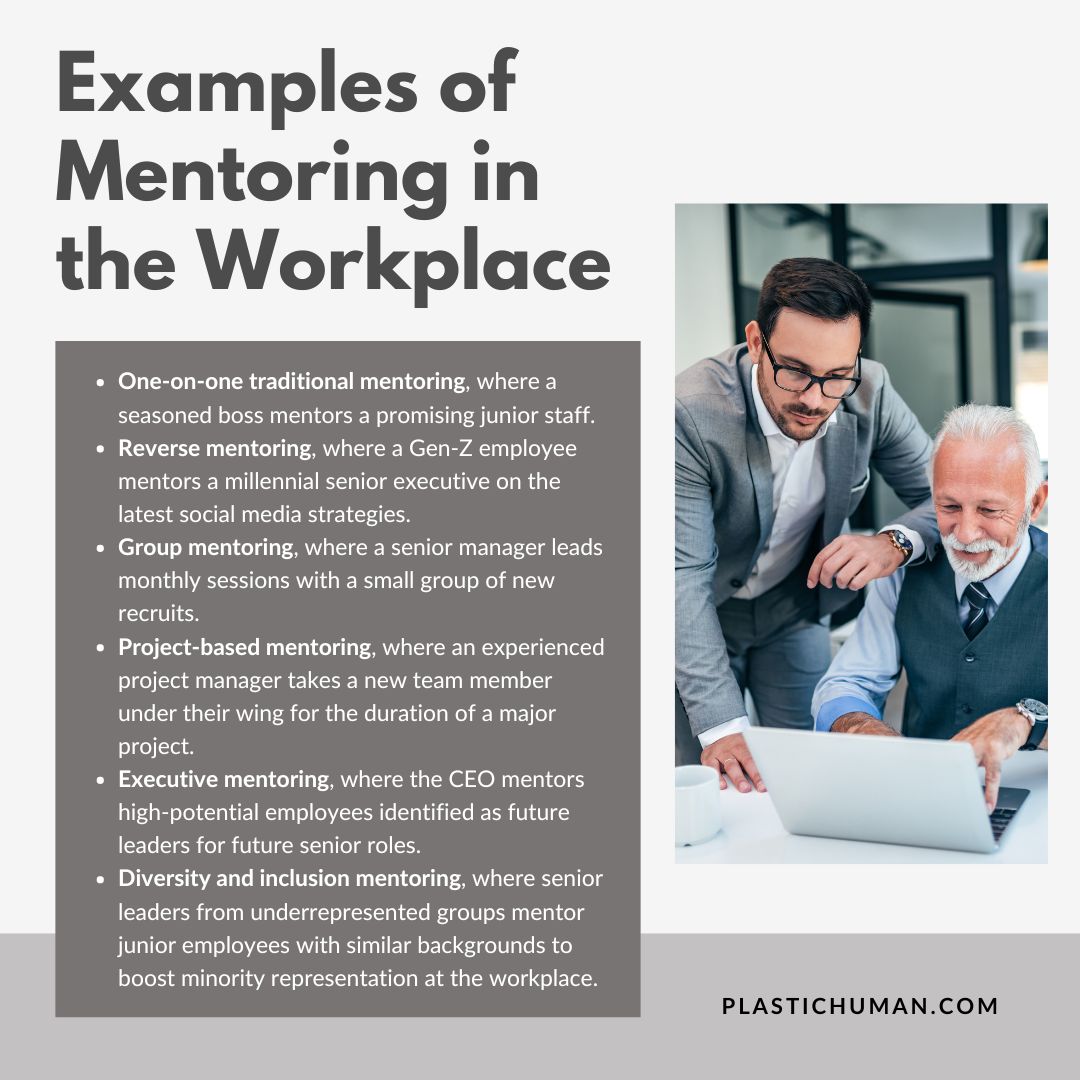
Some Examples of Mentoring in the Workplace:
There are different types of mentoring. Each form can be tailored to the specific needs of the individuals and organizations involved. These include:
- One-on-one traditional mentoring, where a seasoned boss mentors a promising junior staff.
- Reverse mentoring, where a Gen-Z employee mentors a millennial senior executive on the latest social media strategies.
- Group mentoring, where a senior manager leads monthly sessions with a small group of new recruits.
- Project-based mentoring, where an experienced project manager takes a new team member under their wing for the duration of a major project.
- Executive mentoring, where the CEO mentors high-potential employees identified as future leaders for future senior roles.
- Diversity and inclusion mentoring, where senior leaders from underrepresented groups mentor junior employees with similar backgrounds to boost minority representation at the workplace.
Great leaders are lifelong learners, and great workplaces are built on a culture of continuous growth and support.
Yes, being a leader, mentor, or mentee is no easy task. However, you can still make the best of mentorship programs. You only need to have the right approach and a commitment to overcoming these hurdles. Before long, you’ll realize the rewards of mentoring far outweigh the difficulties.
One great approach to maximizing the benefits of mentoring in the workplace is through continuous learning.That’s why I urge you to check out my blog and podcast for career-empowering and life-changing content. You’ll find valuable insights that’ll help you level up your leadership game and create a workplace where everyone can grow.
Talking about leadership, check out my pick of the best books for leadership that’s sure to take you to the next level. See you at the top!