

Remember that popular saying, “Knowledge is power?” Well, with how fast-paced and competitive today’s business world is, knowledge isn’t just power; it’s survival! Every business is always on the lookout for ways to outpace their competitors. It’s sink or swim: either you do that successfully and stay relevant in the business space or relax and get left behind. And the key to staying ahead of the curve is to continually seek knowledge!
However, having knowledge scattered across emails, sticky notes, and even people’s minds is like trying to find something in a cluttered, disorganized mess inefficient and confusing. All this knowledge can only be maximized and leveraged when it’s well-organized and made easily accessible. Think of it as turning your company’s collective brain from a messy drawer into a well-organized toolkit. That’s where having a knowledge manager on the company’s payroll can make all the difference.
So, who exactly is a knowledge manager? What roles do they play within an organization? Why are they becoming a crucial cornerstone for modern businesses? Let’s find out!

What is a Knowledge Manager?
According to most knowledge manager job descriptions, knowledge managers are the folks responsible for capturing, organizing, and sharing both explicit knowledge (the stuff you can write down) and tacit knowledge (the trickier “know-how” that lives in people’s heads).
A knowledge manager is the unsung hero working behind the scenes to drive a company’s continued success. He transforms your company’s scattered brilliance into a well-oiled knowledge management system. A knowledge manager ensures that your company’s brilliant ideas don’t just float around but actually become accessible, usable resources for everyone.
Most landmark achievements and inventions often start with one simple idea or a collection of different ideas from multiple sources. The latter are essentially pieces of a puzzle that, once put together, become a groundbreaking innovation. That’s why idea generation, from top to bottom, is of the utmost importance in every progressive business. However, without a good knowledge manager, all these great ideas may end up amounting to nothing.
Which brings us to the all-important question: What makes a good vs. bad manager in this role? What factors play a role in the type of knowledge manager you become? Well, an effective knowledge manager is like a master chef they need just the right mix of ingredients. He needs to be tech-savvy to efficiently organize multiple ideas, leveraging digital tools like different operating systems to capitalize on the opportunities that come with this digital age.
But, that’s just one of many ingredients. Getting people to share their knowledge isn’t always easy. Ergo, a good knowledge manager needs good people skills. His communication skills should also be refined and adaptable to different scenarios. He should also be adept at project management and strategic thinking, among so many other qualities.
Why Is Knowledge Management Important?
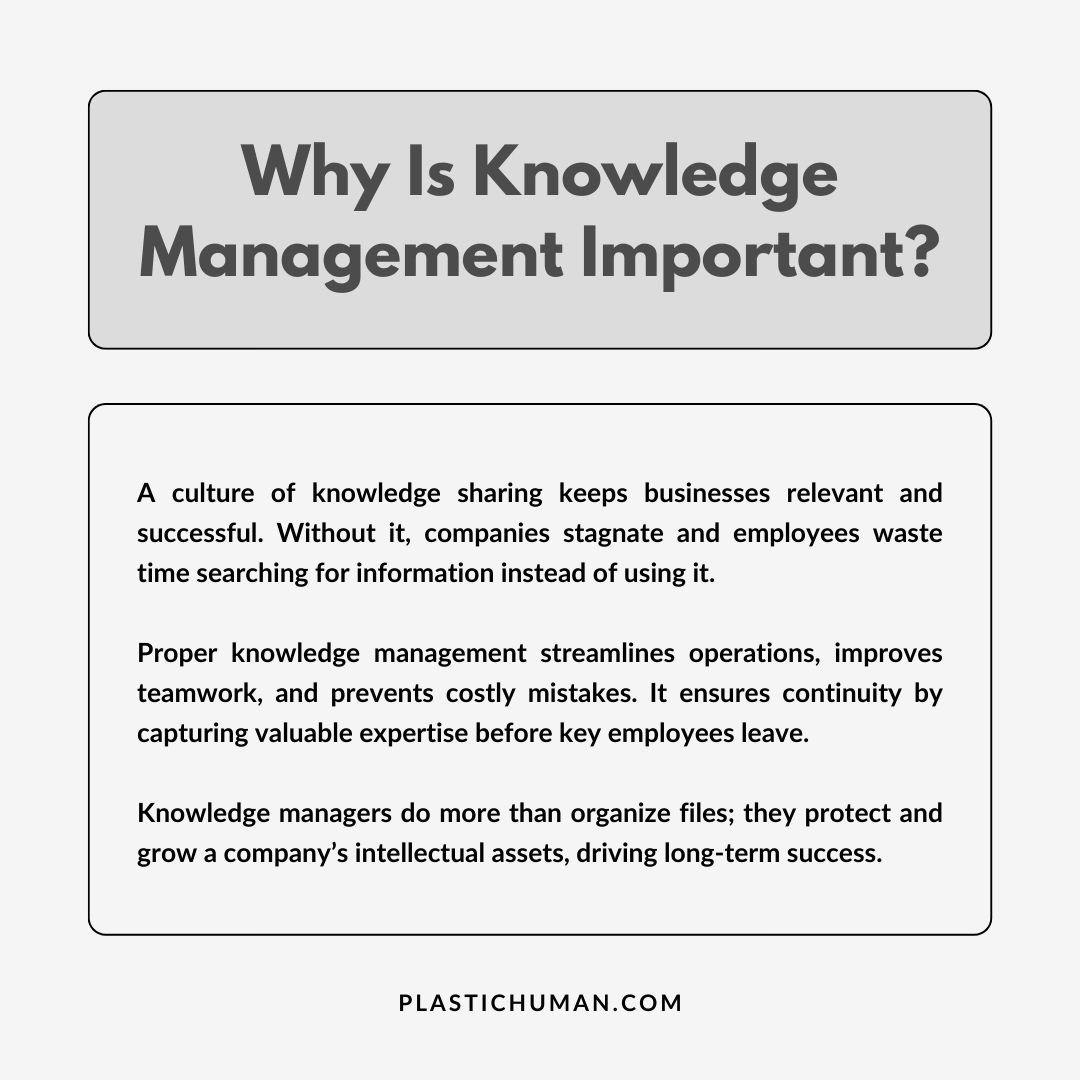
Do you want a workplace that’s progressive? Do you desire lasting success and relevance in your business? Then, you need to cultivate a culture of knowledge sharing in the workplace. A company where ideas don’t flow will stagnate and eventually be left behind. Hence the need to have a proper knowledge management system in place.
When you’re implementing knowledge management properly, your organization becomes like a giant brain that keeps getting smarter. Every project, success, or even failure, becomes part of your learning process.
Whereas, without proper management of your company’s knowledge base, people spend more time hunting for information than actually using it. It’s like having a library where books are arranged in no particular order. That’s a recipe for chaos and time-wasting!
When knowledge flows freely as part of a knowledge management system, good things happen. Every team member works as if they are synchronized. Operations move faster, there are fewer errors, and company goals are more readily attained.
On the other hand, when marketing departments don’t know what IT is doing, and sales don’t understand what product development is cooking up, you get ideas that cause confusion, contradictions, project delays, and even project failures.
There’s more! What happens when your veteran employees decide to retire to that beach in Mexico? Without successful knowledge capture and transfer, decades of valuable experience could walk out the door with him with no measures in place to promote continuity. This means that the company’s future is basically in the hands of this one employee. That’s far from ideal!
This shows that the responsibilities of a knowledge manager go beyond just organizing files. They’re essentially protecting and growing your organization’s intellectual assets. It’s why organizations need leader-managers who can see the big picture while managing the nitty-gritty details of knowledge flow.
What Are the Tasks of Knowledge Managers?
As mentioned earlier, the knowledge management role goes beyond just collecting data or organizing ideas. So, what EXACTLY are these tasks?
Below are some tasks knowledge managers perform within an organization that drives lasting organizational success:
Knowledge Mapping and Assessment
Knowledge mapping is like creating a map for organizational intelligence. It’s about understanding the current knowledge landscape and identifying critical knowledge assets.
This task requires key activities like:
- Conducting comprehensive knowledge audits across departments
- Identifying knowledge gaps and potential risks
- Creating visual representations of knowledge flows
- Assessing the current state of organizational learning
- Determining critical knowledge required for strategic objectives
Indeed, knowledge mapping and assessment are not as easy as they sound. Nevertheless, it’s very much doable. In fact, knowledge managers can make this task much easier to accomplish by taking certain steps. This includes:
- Using advanced mapping technologies
- Developing cross-functional assessment teams
- Creating dynamic, regularly updated knowledge maps
- Integrating both quantitative and qualitative assessment methods
- Aligning knowledge mapping with organizational strategic goals
Knowledge Capture and Documentation
This task transforms fleeting insights into lasting organizational memory. As a result, it helps in preserving intellectual capital that might otherwise disappear. Effective knowledge managers use several techniques for capturing and documenting knowledge, including:
- Designing structured interview protocols
- Creating user-friendly documentation templates
- Developing multimedia knowledge capture approaches
- Implementing storytelling-based knowledge collection
- Building systems that encourage ongoing knowledge documentation
To facilitate an effective knowledge capture and documentation, you can utilize some of the implementation approaches below:
- Make knowledge capture feel conversational.
- Develop psychological safety for knowledge sharing.
- Create recognition programs for knowledge contributors.
- Use technology to simplify documentation processes.
- Design inclusive capture mechanisms that respect different communication styles.
Knowledge Organization and Curation
Here, raw information transforms into a sophisticated, accessible knowledge management system that serves the entire organization. But this doesn’t happen spontaneously. Rather, it’s a product of taking proactive actions and strategically setting things in motion within an organization.
Some organizational strategies a knowledge manager can use to organize and curate knowledge include:
- Developing robust taxonomies and classification systems
- Creating intuitive search and retrieval mechanisms
- Implementing version control and content lifecycle management
- Designing scalable knowledge infrastructure
- Ensuring information security and access management
However, there are certain practices that can help promote effective knowledge organization and curation. These include:
- Regular auditing and refreshing of knowledge repositories
- Using AI and machine learning for smart categorization
- Creating metadata strategies that enhance discoverability
- Designing user-experience-focused interfaces
- Balancing standardization with flexibility
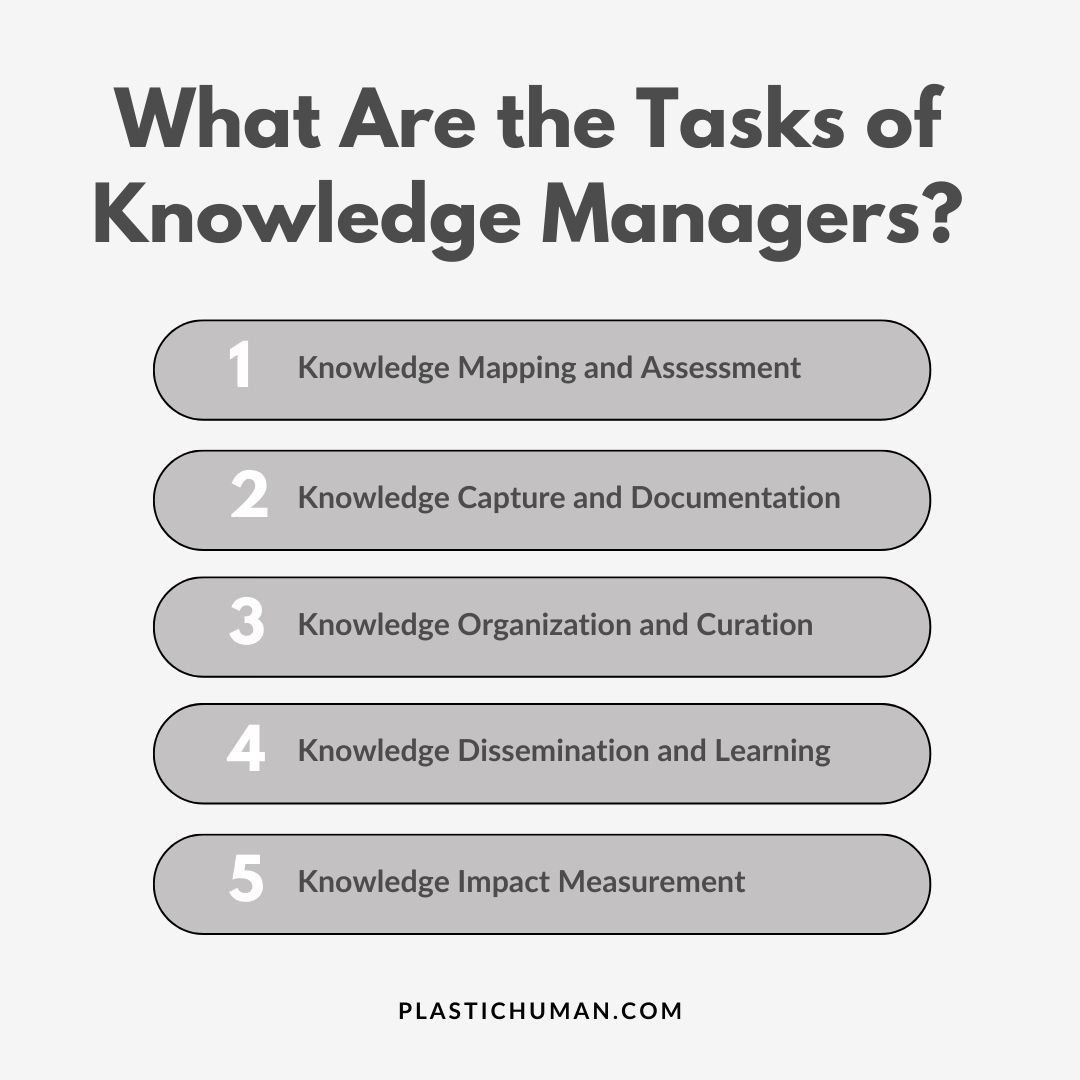
Knowledge Dissemination and Learning
This task turns knowledge from a static resource into a dynamic, living ecosystem of organizational learning. So, how can you effectively disseminate information and knowledge within an organization? Below are some knowledge distribution methods that have proven effective in the workplace:
- Designing multi-channel knowledge transfer approaches
- Creating engaging learning and training programs
- Developing mentorship and peer-learning frameworks
- Implementing collaborative knowledge platforms
- Fostering a culture of continuous learning
How can you fast-track knowledge dissemination and learning in the workplace? You can achieve this by doing the following:
- Using storytelling and narrative approaches
- Creating psychologically safe knowledge-sharing environments
- Developing cross-functional learning opportunities
- Designing technology-enabled knowledge distribution
- Implementing performance support mechanisms
Knowledge Impact Measurement
A knowledge manager’s job description is not complete without this final crucial task. The task entails understanding and demonstrating the tangible value of knowledge management efforts. After all, what use is all we’ve discussed if there’s no positive change and progress of note within an organization? Hence, the need for ongoing measuring of the success of knowledge management in the workplace.
Common measurement approaches include:
- Developing comprehensive knowledge management metrics
- Creating ROI assessment frameworks
- Tracking knowledge utilization and application
- Measuring learning and performance improvements
- Designing feedback loops for continuous improvement
The knowledge manager role combines the best parts of teaching, organizing, and strategic thinking.
Knowledge managers help businesses transform scattered insights into a powerful, actionable resource. As such, having a solid knowledge management strategy isn’t just a “nice to have” it’s essential in today’s fast-paced business world. Whether you’re looking to hire a knowledge manager or become one yourself, understanding this role is your first step toward building a smarter, more efficient organization.
Aside from this, there’s so much more to learn. Continuous personal development is another trait of progressive businesses. That’s why you should join our community of forward-thinking leaders who are already revolutionizing their businesses through effective knowledge management and more.
Don’t let this be just another browser tab you forget all about after closing! Instead, subscribe to our weekly blog and podcast for fresh leadership insights, tips, and strategies. We also have curated lists of the best business management books for every manager who wishes to grow or reinvent himself. See you there!