

You know what’s funny? Many people think being a great manager means having your fingers in every pie, checking every detail, and basically being everyone’s work shadow. Little did they know that the best way to manage is to… well, manage less. Sometimes the best way to lead is to take a step back.
What most managers don’t realize is that micromanaging wasn’t just driving everyone crazy it was actually holding their team back. And although there are many different management styles, most leaders are starting to appreciate the transformational impact of the hands-off manager approach.
But what exactly is the hands-off management style all about? Is it even worth reinventing yourself by adopting this style in your workplace? Let’s find out!

What’s a Hands-Off Management Style?
The hands-off management style is an approach that might seem counterintuitive at first, but has proven to be remarkably successful in modern workplaces. Think of it as teaching someone to ride a bike at some point, you have to let go of the handlebars, even though conventional wisdom might scream otherwise. This style of management challenges traditional notions of leadership and control, offering a fresh perspective on how to guide teams toward success.
At its core, this approach involves setting clear objectives and expectations, then stepping back to let employees determine how best to achieve them. The manager becomes more of a resource and mentor than a taskmaster, available when needed but not hovering nearby. They focus on creating an environment where teams can thrive independently, making decisions and solving problems on their own.
What makes this style unique is its emphasis on development through experience. Rather than prescribing solutions, hands-off managers encourage their teams to experiment, learn from mistakes, and develop their own problem-solving strategies. They provide the guardrails and support structure but leave plenty of room for creativity and innovation within those boundaries.
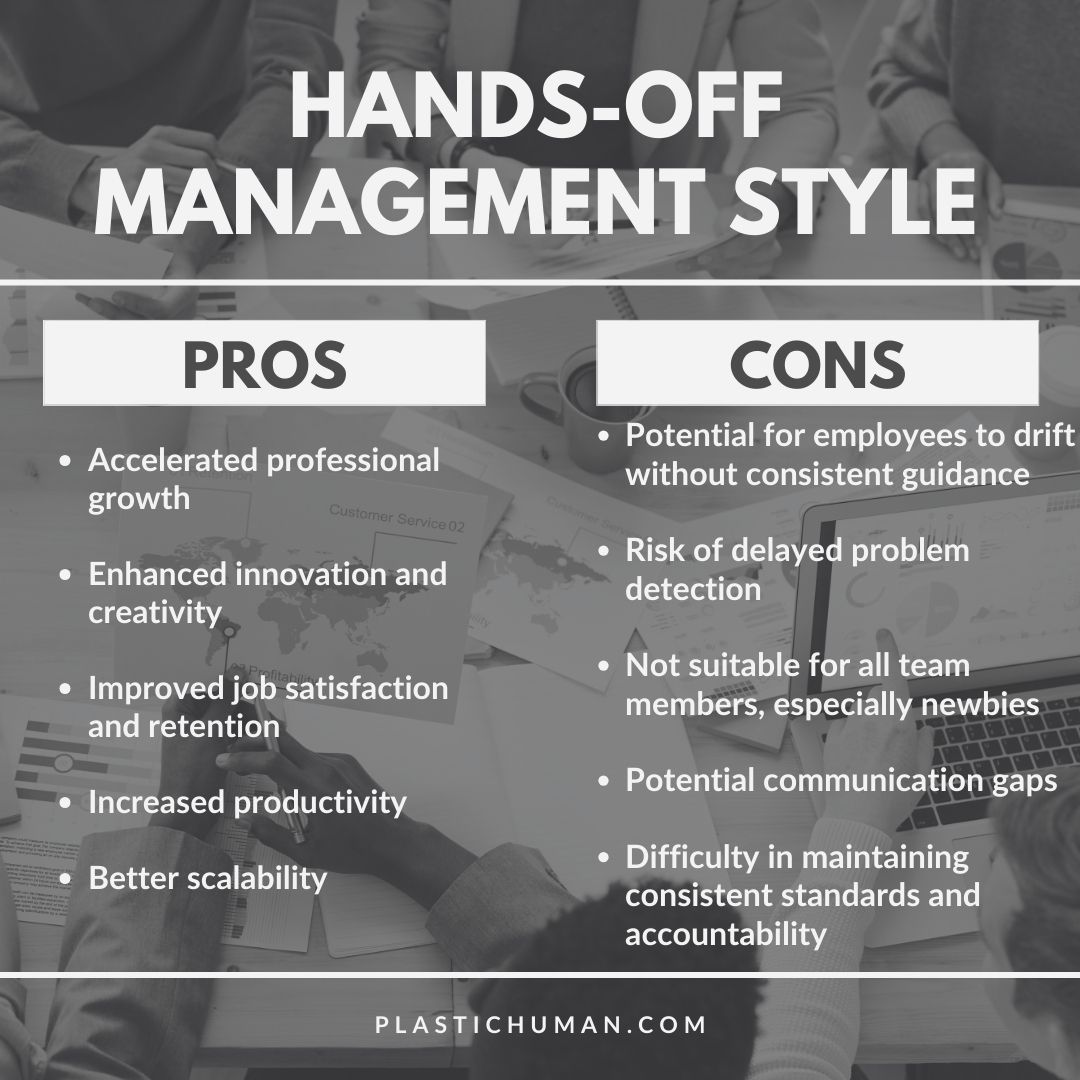
Pros and Cons of a Hands-Off Management Style
Pros
This management approach is proving effective in the following ways:
- Accelerated professional growth
- Enhanced innovation and creativity
- Improved job satisfaction and retention
- Increased productivity
- Better scalability
Cons
While this approach offers many advantages, it also comes with its own set of challenges. Here’s what to watch out for:
- Potential for employees to drift without consistent guidance
- Risk of delayed problem detection
- Not suitable for all team members, especially newbies
- Potential communication gaps
- Difficulty in maintaining consistent standards and accountability

Is the Hands-Off Leadership Style Effective?
The effectiveness of hands-off leadership isn’t a simple yes or no question. It’s more about finding the right fit for specific organizational contexts. Think of it like choosing between an automatic or manual transmission car: neither is inherently better, but each serves different purposes and everyone has a preference.
This management style particularly shines in organizations that prioritize innovation and creativity. Technology companies, creative agencies, and research institutions often find that giving team members the freedom to explore and experiment leads to groundbreaking solutions and fresh perspectives. When employees aren’t constrained by rigid oversight, they’re more likely to push boundaries and think outside conventional limits.
Start-ups and scale-ups can also benefit significantly from this approach. In these fast-paced environments, the ability to make quick decisions without running everything up the chain of command can be the difference between seizing or missing opportunities. Moreover, when leadership bandwidth is stretched thin during rapid growth phases, having self-sufficient teams becomes not just beneficial but essential.
However, context matters enormously. Organizations dealing with high-risk scenarios, such as healthcare facilities or financial institutions, might need to balance hands-off leadership with appropriate oversight mechanisms. In these cases, a modified approach might work better one that maintains necessary controls while still fostering autonomy in less critical areas.
The journey to becoming an effective leader often involves knowing when to step back and let your team soar.
The hands-off management style isn’t necessarily a one-size-fits-all solution; it represents a powerful approach that can transform both organizational culture and results when implemented thoughtfully. Every leader-manager must understand what their team needs to achieve their organizational goals. Then, you should find the right balance between freedom and guidance towards actualizing those goals.
Ready to revolutionize your leadership approach and stay ahead of the latest management trends? Subscribe to our weekly blog and podcast! You’ll receive exclusive insights on how to become excellent leader-managers, team development strategies, and expert management tips. You’ll also have access to some of the best business management books that will take your leadership game to the next level. See you there!