

Good leadership goes beyond just bossing people around or holding a senior position. Instilling an army leadership-like environment where you’re always barking out orders so old school. Nowadays, it’s all about motivating people, introducing change, and ensuring your team wants to zealously work at their highest capacity.
I’ve seen firsthand how leadership can change an organization positively, especially when the leader is the right one. The teams become more effective, employees are happy, the environment of the organization is vibrant, and everyone works in harmony to accomplish the mission together. On the flip side, I‘ve also seen how a lack of leadership can drain all the life out of a business.
Here’s the thing, though: everyone is unique in their own ways. So, there’s no one-size-fits-all approach to leadership. Some leaders like to get in the thick of the action, while others are more like pilots, opting to remain a bit distant but oversee all that is happening. And you know what? That’s okay!
Every leadership type has its benefits and drawbacks. It’s all about finding what works best for you and your team. That’s why I’m dedicating this post to breaking down two major leadership approaches: direct leadership and organizational leadership. Let’s dive in!

Direct Leadership vs. Organizational Leadership
These two leadership styles are like the chocolate and vanilla of the leadership world classic, widely used, and each with its own distinct flavor.
Direct leadership is your roll-up-your-sleeves, get-down-to-business style of leadership. It is typical for relatively small teams or startups, where the team leader is just next to you, helping to get things done. Think of a head chef in a busy kitchen or a project manager on a construction project. Of course, they are giving orders, but they are also not hiding in the back, being bosses; they are right there with the team.
Direct leadership is used a lot in areas that need quick decision-making and prompt action like in police forces, military units, or even sales departments. Immediate action, clarity, and decisiveness are natural products of this leadership style.
On the flip side, organizational leadership is your C-suite market domain, where CEOs, FDs, COOs, and CTOs are navigating the entire vessel and not just individual oars. This style is commonly used where there are many levels of leadership hierarchy: large companies, government departments, etc.
These leaders are the ones who establish organizational goals and directions. They are also responsible for influencing an organizational and strategic culture. Making strategic managerial decisions is another delicate task that can make or mar the business. The effect or influence may range from being a masterstroke to a complete disaster.
Organizational leadership excels in environments requiring critical planning and a systematic view of the proposition. This is basically your ‘default mode’ for dealing with what might be a complex business environment, supervising numerous personnel in various divisions, or leading an institution through major changes.
What is Direct Leadership?
Direct leadership is the kind of captaincy or management where expressing leadership is face-to-face; you do everything right in the presence of your team. It’s a type of leadership where it’s like the leader is breathing down the worker’s neck, but in a positive manner.
But, what really fuels direct leadership? Well, it’s all about the direct impact, as well as directly coaching your team on how to get things done. Think of a basketball trainer during a final match. They’re not mere spectators but are barking out orders, responding to events in real-time, and changing strategies on the same.
Below are the components that make up direct leadership:
- Face-to-face communication: Direct leaders want to get their hands dirty with the team they are managing. They are not camouflaging themselves behind emails or memoranda.
- Quick decision-making: These leaders do not have the time to engage in long discussions or even arguments. They make decisions quickly and do not need extended time to think and deliberate on a decision.
- Clear instructions: This means there’s no confusion or ambiguity in everyone’s role. Direct leaders provide clear-course instructions that can be followed to the letter.
- Immediate feedback: Do a good job? You will surely hear of it very soon. Messed up? You’ll know that too. It’s all about the real-time course correction in an organization.
- Leading by example: Direct leaders don’t just talk the talk – they walk the walk. They are, most of the time, seen alongside different squad sections, executing the tasks with them.
This type of leadership is characterized by its personal approach. It’s leadership you begin to notice leadership that is audible and palpable, if I may add. This style helps the leader build a clear bond with the employees who happily work for him too. It is used to motivate people, keep expectations clear, and get things done as fast as you can.
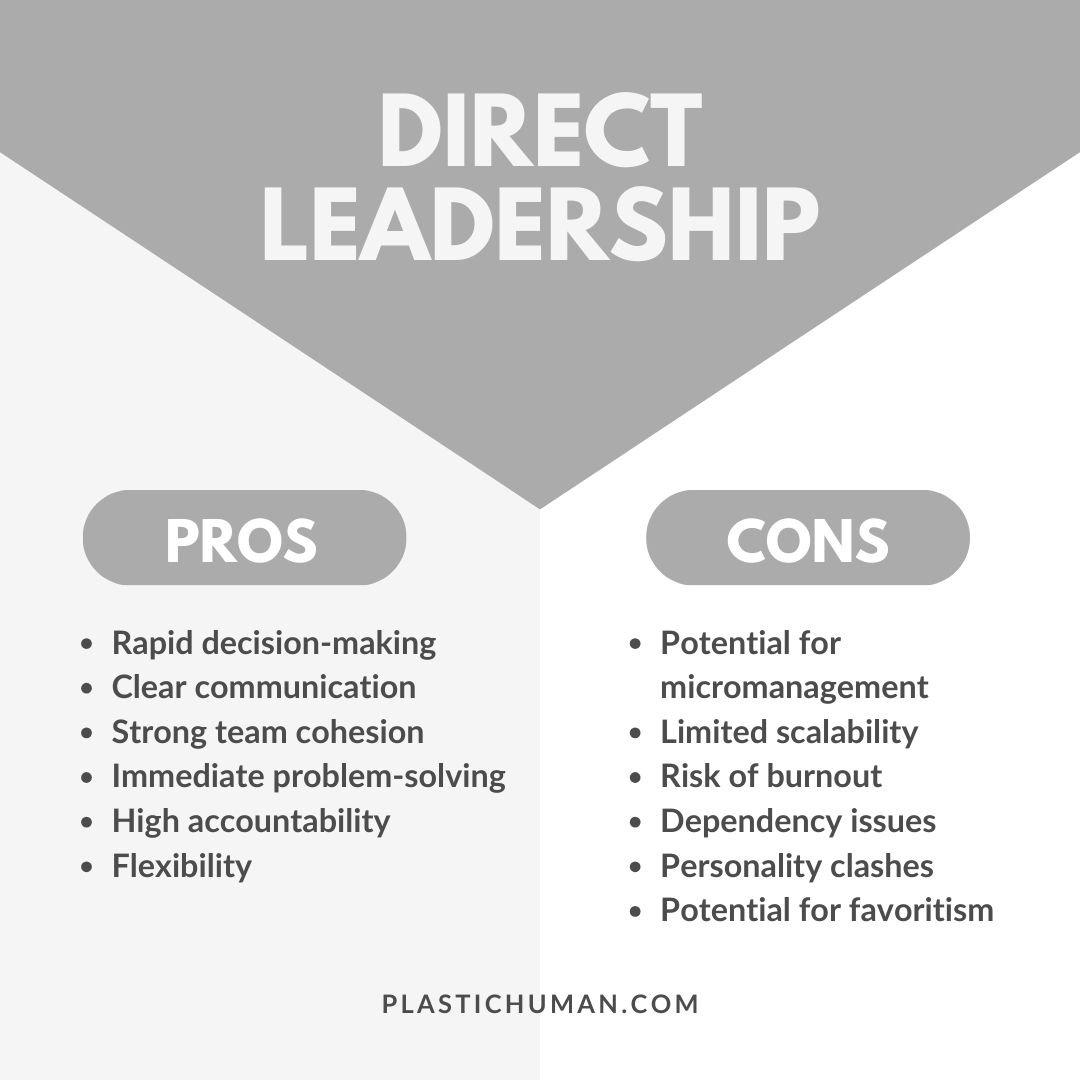
Direct Leadership Pros and Cons
Like any leadership style, direct leadership isn’t all sunshine and rainbows. It has its strengths and weaknesses, its ups and downs.
Pros:
- Rapid decision-making
- Clear communication
- Strong team cohesion
- Immediate problem-solving
- High accountability
- Flexibility
Cons:
- Potential for micromanagement
- Limited scalability
- Risk of burnout
- Dependency issues
- Personality clashes
- Potential for favoritism
What is Organizational Leadership?
Organizational leadership is the process of being in charge of the whole picture rather than focusing on just a section. It’s about charting a course, defining a strategy and a direction, and leading an entire enterprise to its goals. Think of it as being the conductor of an orchestra rather than playing a single instrument.
Key features of organizational leadership include the following:
- Strategic thinking: These leaders are always forward-thinking, organizing, and preparing for the future and for what they expect to happen.
- Culture shaping: They define the organizational culture in terms of values, behaviors, and attitudes, right from the top management levels.
- Big-picture focus: They do not lose sight of the big picture and main goals while being occupied with daily work.
- Delegation: The organizational leaders understand they cannot go it alone. These people excel at delegating work and, in many cases, encouraging others to take charge.
- System-wide communication: That’s because they are especially adept at delivering messages within various organizational levels and branches.
- Change management: These leaders lead their organization’s change processes and assist everyone in changing their mindset.
What makes organizational leadership unique is its scope and scale. This leadership style is not about being a team manager; it’s about being a part of a larger system of teams, departments, and other interested parties. Being a success as an organizational leader also requires acquiring certain skills, including abstract reasoning, system thinking, and how you handle people you might not interact with directly.
Organizational leaders are like chess players, always thinking several moves ahead. They are not only fixing today’s issues but also securing the organization’s future. Thus, they have to balance multiple priorities, manage diverse stakeholder interests, and make decisions that have far-reaching consequences.
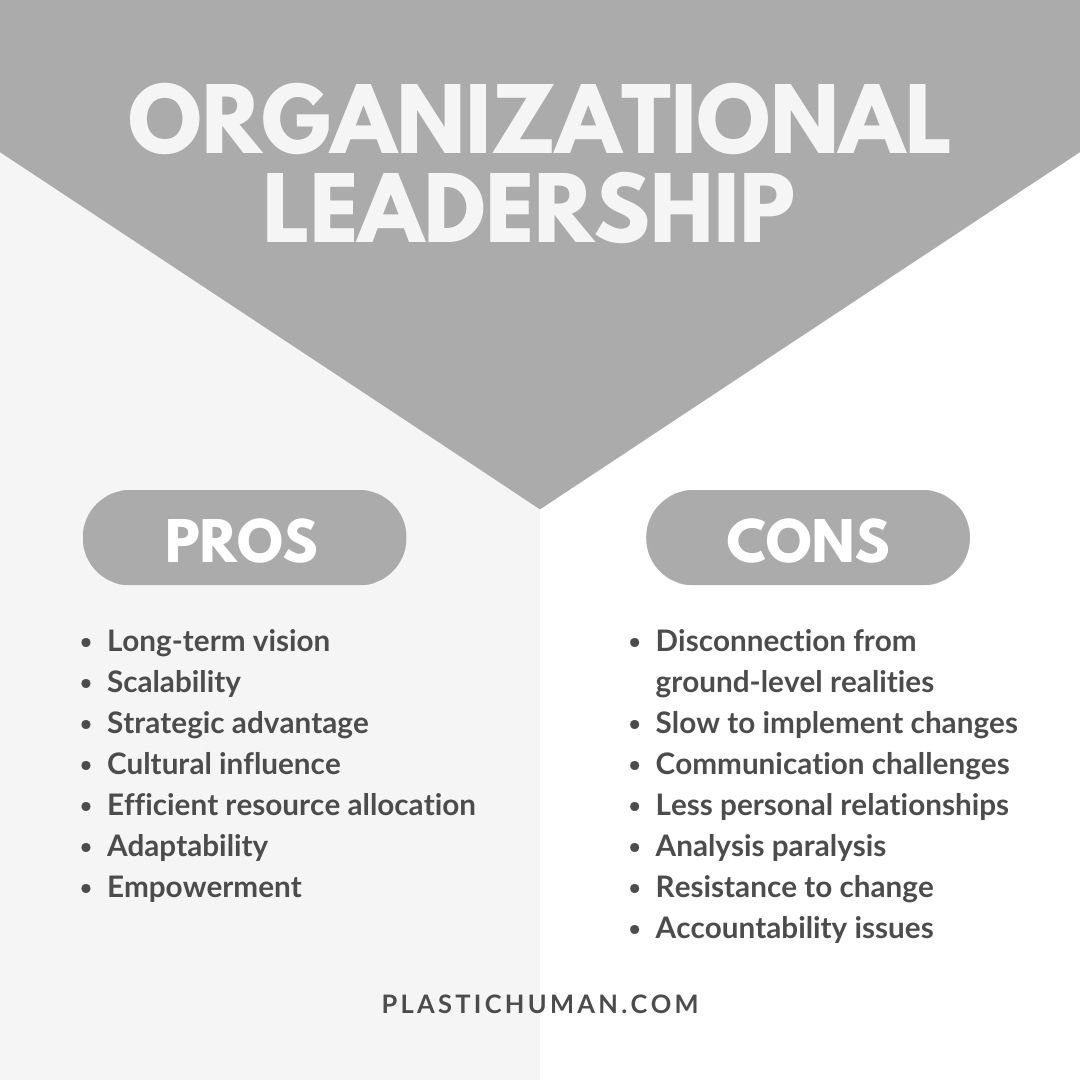
Organizational Leadership Pros and Cons
Just like its more hands-on cousin, organizational leadership comes with its own set of benefits and challenges.
Pros:
- Long-term vision
- Scalability
- Strategic advantage
- Cultural influence
- Efficient resource allocation
- Adaptability
- Empowerment
Cons:
- Disconnection from ground-level realities
- Slow to implement changes
- Communication challenges
- Less personal relationships
- Analysis paralysis
- Resistance to change
- Accountability issues
Direct Leadership versus Organizational Leadership: Which is Better?
This is like asking whether a hammer is superior to a screwdriver. They’re different tools for different jobs. Direct leadership thrives within small innovative setups. Such setups are often characterized by the need for high working speeds, an individual approach, fast decision-making, and prompt action taking. Examples include emergency services, a restaurant’s kitchen, or event organization.
At the same time, organizational leadership best suits large corporate businesses or government organizations. This leadership style is needed to successfully navigate a business through industry changes, deal with various stakeholders’ interests, or create lasting cultural shifts.
Most exemplary leaders can easily toggle between these two leadership styles when the need arises. You can use organizational leadership to set the overall vision, then switch to a more direct style when you need to rally the troops for a specific project.
What does being a leader mean to you? Drop a comment below!
Whatever the case may be, know that your journey to become an awesome leader doesn’t have to be a lonely process. It’s for this reason that I invite you to listen to my podcast and read my blog posts.
Therein, you will find a depot of inspiring tips, real-world success stories, and other transformative leadership content that will take you to the next level.You can also take a moment to check out these 10 Best Books on Leadership. They will DEFINITELY be worth your read!