

Have you ever experienced a situation whereby you walk into a company and something just feels off? Maybe the energy’s all wrong, or people are constantly butting heads, or worse, everyone’s just going through the motions without any real passion. It’s off-putting, isn’t it? But here’s the thing I’ve realized after studying years of millennial management: how managers lead can make or break an organization.
I mean, think about it. A great manager can turn a group of individuals into a great team. On the other hand, a poor or non-effective manager can drain the life out of the best talents in the organization. It’s wild how much impact one person’s leadership and management style can have on an entire company’s morale and productivity.
Here is another interesting fact: just like any other human being, not all managers are the same. You’ve got the micromanagers, the ones who delegate tasks each and every time, the by-the-book sticklers, and then… you’ve got your leader-managers. The latter are extraordinary people who can actually transform an organization from the inside out.
That’s why I’m dedicating this post to explaining why organizations desperately need these leader-manager types. Let’s get into it.
Why Do Organizations Need Leader-Managers?
Leaders are like the superglue that keeps organizations together. Something that I found compelling about them is how they seem to instill unity within a group. Once you have a leader-manager on board, everyone’s not just working for a paycheck; they’re part of something bigger and commit to working for a common goal.
Leaders are also great at adapting to the needs of their subordinates. They know how to speak to, and therefore motivate, based on the audience. They’re adaptable in their approach, if you will. Sometimes you need to motivate employees to get the best out of them, and at other times, they need a teacher. On certain occasions, they will also need a disciplinarian. Leaders are people who are able to determine and become what a team needs at a given moment.
Problem-solving is another thing leader-managers excel at. When a good manager sees a problem, he’ll be all-out in search of a quick fix. If a leader faces the same problem, he’ll view and address it as a potential opportunity. A leader-manager, on the other hand, will do both. They address the challenge that is at hand while also thinking about how to turn it into a long-term win.
Finally, and probably the best part, leader-managers create more leaders in the organization. It makes them more like the wandering charlatan who, unlike Johnny Appleseed, just sows leadership skills wherever he treads. They don’t just want to be the smartest person in the room; they want to build a room full of smart, capable leaders.

What Is the Difference Between a Leader and a Manager?
Think of a manager as the person who ensures that the train arrives on time. They are very procedural, time-conscious, and goal-oriented organizations. They’re the ones policing and ensuring everyone is delivering their assignment within the stipulated time and in adherence to the guidelines. Essential? Absolutely. But sometimes, it can feel a bit mechanical.
Leaders, on the other hand, are the ones who stir people’s passion and interest, making them want to get on the train. Leaders set the pace, encourage people, and always look at the bigger picture. They’re all about vision, change, and pushing boundaries.
But why choose when you can have both? Being both a manager and leader is like having a Swiss Army knife of management they’ve got all the tools!
A leader-manager possesses the best qualities of both worlds. They have managerial skills, which make them efficient in organizing things to ensure business operations run as planned. And they also have that certain leadership touch that makes people want to put in extra effort and work harder.
Leader-managers do not simply order the team to achieve a 10% sales increment within the week. They describe the kind of future that an additional 10% could help bring to the company and to each team member. Then, they roll up their sleeves and actively participate in the process to ensure it is done. They’re not just barking orders from an ivory tower. Rather, they get off their high management-position pedestal and head to the workstation, leading and managing by example.
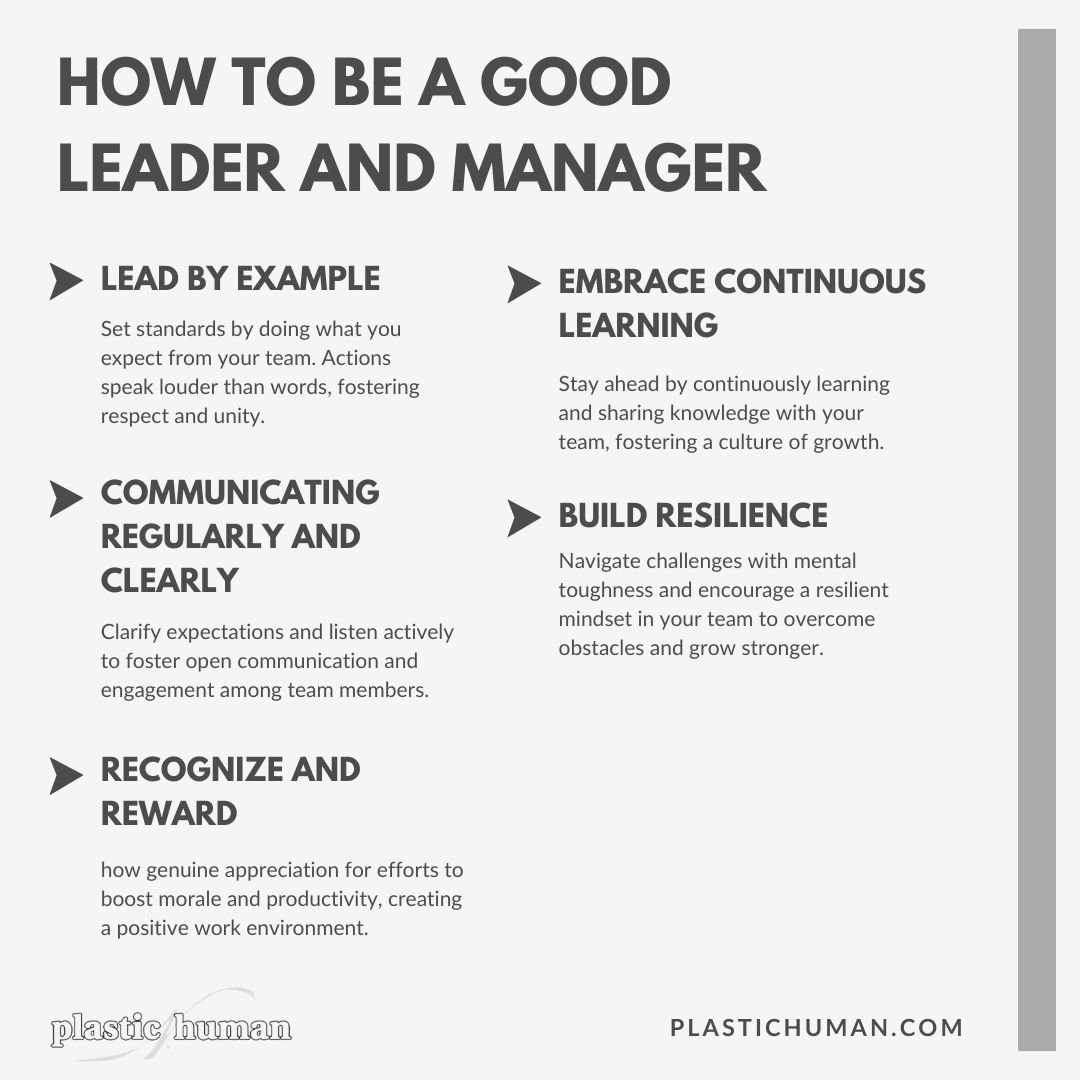
How to Be a Good Leader and Manager
Now, let’s get down to the practical aspect of how to become a great leader- manager. I know it may sound “easier said than done” to some people. Well, yeah, it’s not a walk in the park. But then again, nothing is impossible if you really want it. You only need to have the right mindset, put SMART goal-setting in action, and get to work.
Lead by Example
Leadership is about setting standards, so you shouldn’t expect your team to do things you’re not willing to do yourself. Want your team to show up on time? Be the first one in the office. Want them to take risks? Live by your own rules and show them how it’s done.
There is a saying that goes, ‘Actions speak louder than words.’ When you lead by example, you don’t only give instructions to the team; you also demonstrate. By doing so, you earn respect and trust. Your team will also radiate that feeling of ‘we’re all in this together.’ This is far more effective than any pep talk you could give.
Communicating Regularly and Clearly
Communication is regarded as the lifeblood of any organization, and as a leader-manager, you’re the heart pumping that blood. Avoid assuming that everyone on the team understands you. Instead, be sure to clarify the expectations, objectives, and big picture in the long term as much as possible.
But here comes the twist: it is not only about talking. Listening is also a key part of employee engagement. Establish effective communication that fosters openness among your team members. Welcome and receive feedback with an open mind so they can freely share their views, express their concerns, and engage in healthy debates.
Recognize and Reward
You would agree with me that people like to be valued in their respective workspaces, correct? Therefore, another way to be a leader-manager is to ensure subordinates know that their efforts are appreciated.
This is not only about giving out ‘Employee of the Month’ trophies (though that’s not a bad idea). Giving them genuine, specific recognition will go a long way toward boosting their morale and productivity. Did someone go above and beyond on a project? Tell them and tell the rest of the team too. Create an environment that rewards good work, and without doubt, there will be more.
Embrace Continuous Learning
Continuous learning and skills acquisition is the only way to stay on top of the demands of this highly competitive and rapidly evolving society. If you’re not learning, you’re falling behind. And this is twice as true for leader-managers.
Stay curious. Books, workshops, podcasts, etc. are what you should embrace as long as they are interesting for you. Discover what your strengths and weaknesses are and work on them
But don’t keep all that knowledge to yourself, though. Give it to your team members and compel them to share it as well. Develop an organizational culture that leaves no room for complacency and where all people are learning and becoming better. When everyone on your team is leveling up together, there is no end to how great your productivity can be.
Build Resilience
Resilience in the work environment refers to the capacity to overcome difficulties and obstacles, handle setbacks, learn from failures, and persist in operation. Leadership is not always smooth sailing through a calm sea. There will be storms, and as the leader-manager stationed at the wheel, a lot is expected of you. You must be mentally hard, know how to navigate a tough decision-making process, while radiating calmness all-through.
You can even go a step further by extending and imbibing this resilient attitude in your team. Teach them how to adopt the ‘glass half full’ mentality when faced with life challenges. Teach them how they can learn from their mistakes, as opposed to dreading them. A resilient team will see challenges as opportunities for growth, weather any storm, and come out stronger on the other side.
Great leadership isn’t a one-hit wonder; it’s more like a never-ending world tour.
And just like how you’d check if a song is copyrighted before using it in your next company video (because, let’s face it, nobody wants a copyright strike on their hands), you’ve got to keep checking in on your leadership skills and fine-tuning them.
Fortunately, you don’t have to go solo on this leadership journey. That’s why I’m inviting you to tune into my podcast and blog. It’s like Spotify for leadership insights always updating, always relevant, and guaranteed to get your leadership muscles moving.
I’ll be dropping new episodes and posts regularly. They’ll be packed with more juicy tips, real-world stories, and other transformative content not just for you but for everyone you lead. See you there!